The rapid rise of virtual platforms like MyWhoosh, One Lap, and Zwift changed everything. Today, indoor cycling is no longer just a rainy-day backup option. Instead, it has evolved into a highly competitive discipline. Top-tier professional riders, like Jay Vine, even used indoor trainers to build WorldTour-level power numbers.
Yet, this shift highlights a massive puzzle for regular riders. Why does a cyclist’s power output look so different inside compared to outside? The answer is quite simple. When you look at sports science, these variations are not accidental. Multiple physiological and mechanical factors shape your indoor cycling numbers.
Jay Vine is the ultimate textbook example of using indoor setups to jump straight into the WorldTour.
Heat Accumulation Overburdens Your Indoor Cycling Biology
First, let us look at heat. Thermal regulation creates the most direct roadblock for your body during indoor cycling. Human muscles are not very efficient machines. In fact, our bodies turn a massive amount of energy into pure waste heat rather than forward motion.
When you ride outside, natural airflow moving past your skin quickly strips this heat away. This process keeps your core temperature stable. Inside a room, however, heat stacks up rapidly without massive industrial fans.
As your core temperature spikes, your brain panics. Your body immediately diverts oxygen-rich blood away from your working leg muscles and pumps it toward your skin to sweat. This defense mechanism instantly chokes your power output. Many riders struggle with indoor numbers simply because their bodies are overheating.
Many cyclists suffer lower power inside because high core temperatures directly suppress muscle performance.
How Smart Trainers Mimic Road Inertia
Interestingly, indoor numbers are not always lower. If your power meter works correctly, flywheels and resistance units alter your numbers. Outside, you fight gravity, rolling resistance, and wind. Inside, smart trainers like the Magene T500 or T600 Eco try to replicate these forces.
Modern smart trainers can mimic real roads with extreme precision. Even so, electronic resistance units cannot fully recreate the true inertia of actual pavement. Indoor trainers use heavy flywheels to generate high rotating inertia. This mechanical layout smooths out your entire pedal stroke.
If your spin is slightly uneven, the indoor flywheel carries you through the dead spots. On a steep outdoor hill, however, your speed drops and inertia disappears. Every tiny mistake in your pedal stroke slows you down instantly. This loss of momentum makes holding a steady wattage outside much harder.
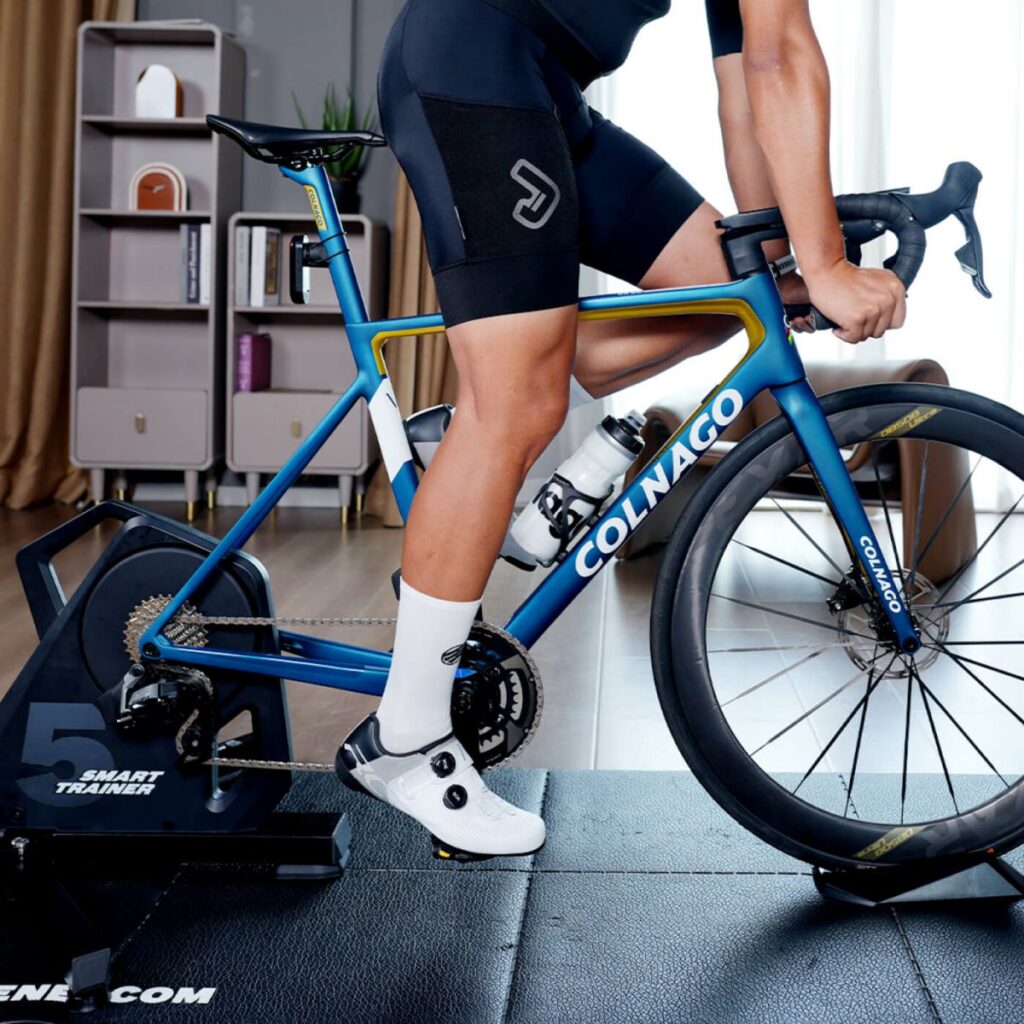
Smart trainers simulate outdoor rides beautifully, but they are still digital approximations.
Virtual Apps Alter Your Biomechanics
Virtual platform settings also widen the power gap. By tweaking your trainer’s “Trainer Difficulty” or gradient scale, you can use larger gears on virtual climbs. This trick increases flywheel speed and mechanical inertia. It makes your pedaling feel buttery smooth even on a 10% gradient.
You can almost never replicate this high-inertia environment on a real, steep outdoor mountain. Consequently, these specific virtual setups can sometimes artificially inflate your indoor wattage numbers.
Indoor trainers offer artificial momentum compared to the raw gravity of outdoor roads.
Overusing ERG Mode Limits Your Power Adaptation
Your chosen workout mode changes how your brain commands your muscles. Many riders rely heavily on ERG mode for structured intervals. In ERG mode, the smart trainer controls the resistance automatically to force you onto a target wattage number.
This automation delivers incredibly precise workouts. Unfortunately, it also strips away your ability to self-regulate your pacing. When you transition back to open roads, you must constantly adapt to changing winds and rolling hills. Riders who over-rely on ERG mode often discover they lack the fine muscle control needed to sustain steady power outside.
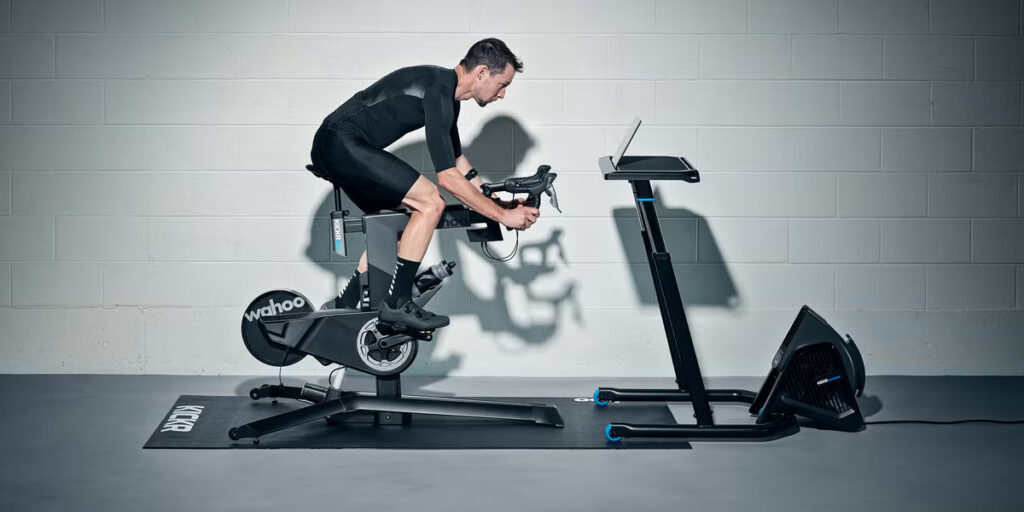
Do not rely on ERG mode exclusively. Smart cross-training unlocks your true physical potential.
Fixed Bike Frames Redefine Muscle Recruitment
Biomechanical tracking shows another massive difference. When you attack a real hill, your bike sways beneath you. This natural side-to-side rock changes your joint angles and recruits different muscle groups.
Standard indoor cycling setups lock your frame completely rigid and level. Unless you buy expensive motion plates or a dedicated simulator bike like the Wahoo Kickr Bike Pro, your frame remains dead straight. Over time, this rigid environment trains your muscles in a highly specific, narrow way that does not match the fluid demands of outdoor riding.
Indoor setups and outdoor roads activate your leg muscles in distinct ways.
Indoor Cycling Cultivates a Unique Pedaling Strategy
Over time, dedicated virtual racers develop a highly specialized pedaling style. This strategy usually features low cadences, massive torque, and unusually long periods of standing out of the saddle.
On a stable trainer, you do not need to balance, steer, or watch for loose gravel. You can safely dump 100% of your energy down into a single direction. On real roads, this aggressive style burns through your matches and causes premature muscle fatigue. Put simply, big indoor numbers do not automatically translate to real-world speed.
Indoor training spaces allow you to develop specialized, one-directional pedaling habits.
Conclusion: Merge Your Data with the Real World
Ultimately, the gap between indoor and outdoor power is not a question of which metric is more accurate. Instead, they represent two entirely different sporting environments. The goal for a smart cyclist is not to force these numbers to match perfectly.
Instead, you must understand the rules of each playground. Figure out which indoor gains transfer to the road, and which ones are just illusions created by your flywheel. You do not need to choose between inside training and outside riding. Integrate the structured control of indoor cycling with the chaotic reality of open roads, and you will turn every drop of sweat into genuine, real-world speed.
Do you smash your power PRs on Zwift, or do you perform better out on the open road? Let me know your experiences in the comments below!
About the Author