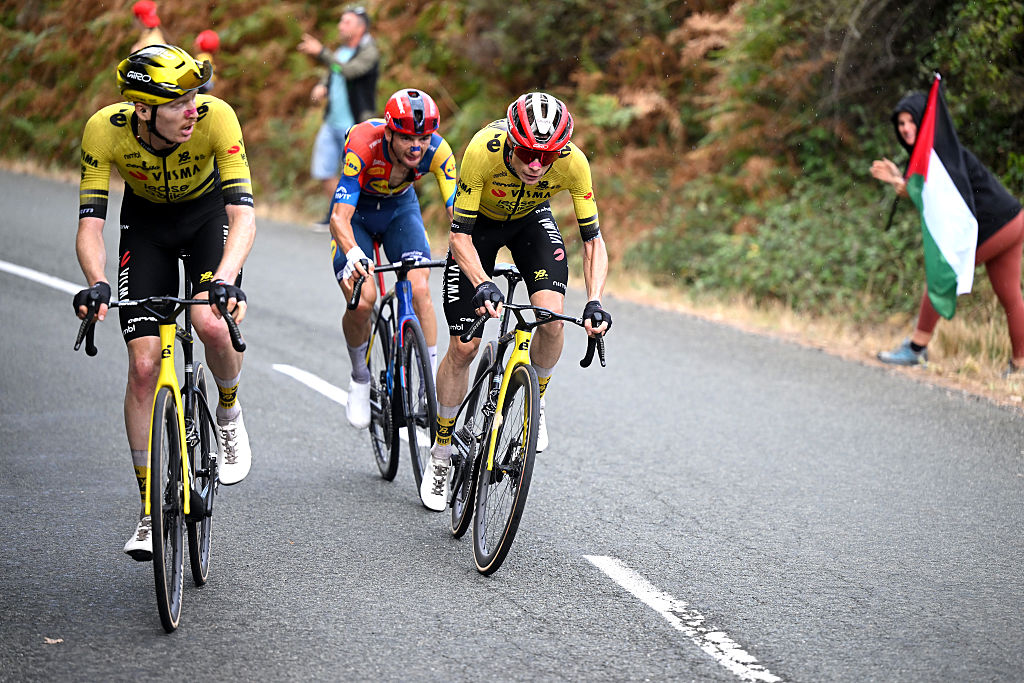
ALFARO, SPAIN - AUGUST 31: (L-R) Matteo Jorgenson of The United States and Team Visma | Lease a Bike, Giulio Ciccone of Italy and Team Lidl - Trek and Jonas Vingegaard of Denmark and Team Visma | Lease a Bike compete in the breakaway during the La Vuelta - 80th Tour of Spain 2025, Stage 9 a 195.5km stage from Alfaro to Estacion de Esqui de Valdezcaray 1541m / #UCIWT / on August 31, 2025 in Alfaro, Spain. (Photo by Dario Belingheri/Getty Images)
Finding the right crank length is a paradox for many cyclists. It is the central lever of the pedaling motion. However, brands long treated it as a standard stock component. Many riders never check if their bike’s crank length actually fits them.
Recently, top pros like Tadej Pogačar and Jonas Vingegaard adjusted their setups. Because of this, the topic is back in the spotlight. The market reacted swiftly and went to extremes. Riders shifted from total neglect to an absolute obsession with shorter components.
Yet, this black-and-white view misses the mark. Bike fitters and sports scientists agree on this point. You cannot reduce this decision to a passing trend or a single correct answer.
Ever since Pogačar and Vingegaard made the switch, the cycling world has gone crazy for short options.
Power Isn’t the Issue—Pedaling Mechanics Are
Many riders once believed that longer cranks provided more leverage. They thought this leverage boosted power output. In reality, scientific research does not back this up.
Changing your crank length alters the relationship between torque and cadence. Longer cranks increase torque and lower cadence. Shorter cranks do the exact opposite. However, these two variables cancel each other out in real-world riding. Your overall power output remains virtually the same. Whether you spin a 165mm or a 175mm crank, the impact on peak power is tiny.
Whether long or short, crank length has a negligible impact on your peak power output.
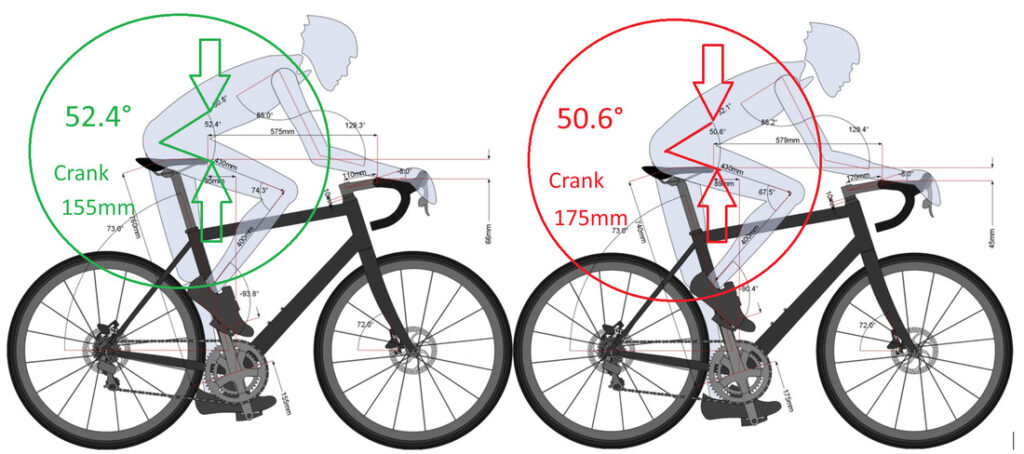
Instead, the real difference lies in the biomechanics of the pedal stroke. A longer crank expands the pedaling circle. This forces your hip and knee into sharp, compressed angles at the top of the stroke. Conversely, a shorter crank shrinks the pedaling circle. This allows your joints to move within a relaxed, open range.
These changes do not instantly show up on your power meter. Instead, they accumulate over hours in the saddle. They deeply affect your pedaling fluidity, core stability, and fatigue. Therefore, good bike fitters do not use crank length to boost power. They use it to free your body from physical restrictions.
The true differentiator of crank length is how it reshapes your biomechanics.
Why Stock Bike Specifications Are Becoming Obsolete
Most stock bikes on the market ship with standard crank lengths. These usually sit between 165mm and 175mm, divided in 2.5mm steps. This looks like a precise matrix on paper. However, it operates on a flawed assumption. It assumes that human body proportions are largely uniform.
We all know reality is different. Even riders of the exact same height have massive differences. They differ in leg-to-torso ratios, hip mobility, and flexibility. Frame size alone should not determine your crank length. If it does, true personalization is impossible.
This explains why many cyclists feel a nagging sense of awkwardness. This happens even after a basic bike fit. Their posture looks correct and their power numbers are fine. Still, the pedal stroke does not feel smooth. Over long distances, this mismatch causes premature fatigue or local discomfort.
Most riders find themselves looking to swap out their stock crank length after spending some time in the saddle.
Finding Your Fit: Listen to Your Body
The best way to find your ideal length is to listen to your body. Pay attention during your next ride. Do you feel pinching in your hips at the top of the pedal stroke? Do your knees feel excessively bent? Does your pelvis rock side-to-side to clear the top dead center?
If you answer yes, your cranks are likely too long. A long crank chokes out your movement space. This biomechanical compensation might not cause an immediate injury. However, it quietly erodes your efficiency and leads to chronic discomfort over time.
Cadence is another major indicator. When the pedaling circle is too large, your nervous system works harder. Your feet must travel a longer path. This makes sustaining a high cadence difficult. It can also cause your rhythm to feel choppy when you try to spin faster.
The most direct path to finding the right crank length is tuning into your body’s physical feedback.
Your riding posture and breathing also provide clues. This is especially true in an aggressive, aerodynamic position. Do your thighs press against your belly at the top of the stroke? Does this action disrupt your breathing rhythm? If so, your hip angle is too closed. An excessively long crank is often the prime culprit.
Furthermore, past injuries and flexibility play a massive role. Riders with limited joint mobility tolerate large movements poorly. If their cranks are too long, their bodies overcompensate to finish the stroke. This mistake significantly spikes your risk of injury.
Crank length is often the hidden culprit behind a compressed, restricted cockpit.
Tuning Is a Total System Rebuild, Not Just a Swapping of Parts
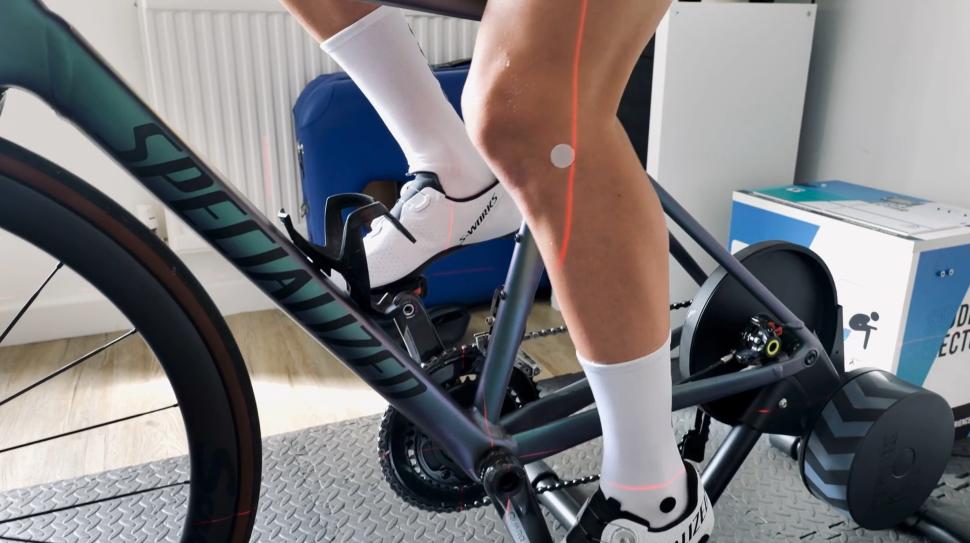
When you change your crank length, you do more than swap a part. You reshape your entire interaction with the bike.
Changing the crank length alters the exact heights of your stroke. Therefore, you must adjust your saddle height at the same time. If you skip this, you will face new discomfort. You might easily blame the new crank length instead of the unadjusted seat height.
Furthermore, a shorter crank requires a higher saddle. This setup shifts your entire weight distribution. You will likely need to re-evaluate your frontend stack height and handlebar drop as well.
Finally, give yourself time to adapt. Tiny adjustments rarely yield noticeable differences. Meanwhile, rushing to judgment ignores the time your muscles need to rewire. Pedaling is a deeply ingrained habit. Any structural change requires time and miles on the road before you can judge its success.
Pedaling is a highly habituated movement pattern. Any change requires a dedicated adaptation period.
Conclusion: It Won’t Give You Free Watts, But It Changes Everything
Crank length will not magically raise your absolute performance ceiling. However, its impact on your movement quality and comfort is profound.
Therefore, do not choose a crank length to chase theoretical maximum wattage. Instead, choose one that lets your body move naturally and stably. The perfect setup is simple. It is the moment a crank stops pinching your joints, stops fighting your cadence, and stops forcing bad compensations.
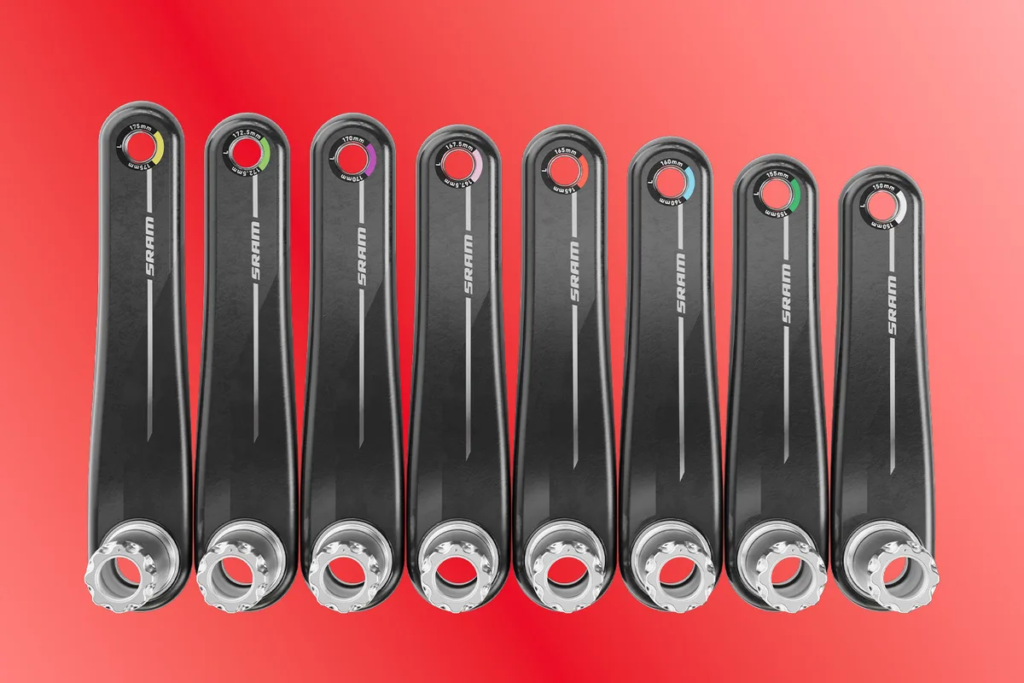
SRAM’s diverse short-crank options now give riders a much wider pool of choices.
Crank length remains a tricky topic because it sits between data and intuition. You cannot neatly read it on a screen like power. Yet, it dictates the quality of every single revolution you make.
Bike setups are becoming hyper-customized. Because of this, crank length is no longer a rigid, factory setting. It is an extension of how well you understand your own body. Ultimately, the perfect length does not have a single answer. It is an open-ended question that requires you to do the homework.
Did you recently switch to shorter cranks, or are you sticking with the traditional length? Let me know your thoughts and how it changed your ride in the comments below!
About the Author